Tampilkan postingan dengan label BMW. Tampilkan semua postingan

More QNX-powered cars and infotainment systems from 2011 CES

The second installment in our CES Cars of Fame series. Today, we look at several systems from the 2011 CES event, starting with this week's inductee, a BMW Z4.

Paul Leroux
I've led you astray — sort of. Last week I stated that the LTE Connected Car, the first QNX-powered technology concept car, appeared at 2011 CES. But I didn't mention that QNX technology was at the core of several other innovative vehicles and infotainment systems at CES that year.

So let me set the record straight. And the best place to start is the QNX booth at 2011 CES, where a BMW Z4 roadster was the front-and-center attraction.

BMW Z4 Roadster with ConnectedDrive
The Z4 wasn't a technology concept car, but a true production car straight off the dealer lot. It was equipped with the QNX-based BMW ConnectedDrive system, which offers real-time traffic information, automatic emergency calling, and a text-to-speech feature that can read aloud emails, appointments, text messages, and other information from Bluetooth smartphones. It's a cool system right at home in this equally cool cockpit:


Heck, the whole car was cool, from the wheels up:


Audi A8 with Google Earth
Mind you, the coolness didn't stop at the QNX booth. Just down the hall, Audi showcased an A8 sedan equipped with the QNX-based 3G MMI infotainment system, featuring Google Earth. This same model drove home with the 2011 Edmunds Breakthrough Technology award a short while later.

I don't have any photos of the Audi from the CES show floor, but if you head over to the On Q blog, you can see some snaps from an automotive event that QNX hosted in Stuttgart two months earlier. The photos highlight the A8's innovative touchpad, which lets you input destination names by tracing them with your finger.

Toyota Entune infotainment system
And now to another award-winning QNX-based system. Toyota Entune embraces a simple, yet hard-to-achieve concept: help drivers interact with mobile content and applications in a non-distracting, handsfree fashion. For instance, if you are searching for a nearby restaurant, Entune lets you ask for it in a conversational fashion; no need for specific voice commands.

You could tell the judges for the CNET Best of CES awards were impressed, because they awarded Entune first prize, in the Car Tech category — the first of three QNX-powered systems to do. QNX Software Systems went on to win in 2011 for its QNX CAR Platform and then Chevy won in 2012 for its MyLink system. Not too shabby.

A cluster of clusters
We've looked at just three of the many QNX-based automotive systems showcased at 2011 CES. For instance, QNX also demonstrated digital instrument clusters built by Visteon for the Land Rover Range Rover and for the Jaguar XJ sedan, below:


Freescale, NVIDIA, TeleNav, and Texas Instruments also got into the act, demonstrating QNX systems in their booths and meeting areas.

Do you have any memories of 2011 CES? I'd love to hear them.

Building a hands-free future

The end of my street is governed by a three-way stop. The other morning I was backing out of my driveway when someone rolled past the stop sign and came within inches of hitting me. I stopped, glared at him, and resumed driving. Two stop signs later, the same guy squeezed past my car (in the same lane), completely oblivious to what he was doing.

Why was he driving like this? Probably because he was deeply engrossed in a conversation on his cell phone.

Where I live, using a handset while driving has been illegal for over a year. You cannot talk, you cannot text, you cannot “Facebook”, you cannot Tweet — even if you're stopped at a red light. This makes perfect sense to me. As a driver, your primary responsibility is to control the vehicle. And yet I see people texting on the freeway, talking on their cell phones, and doing who knows what else on an alarmingly regular basis.

The QNX-powered BMW
ConnectedDrive system
Society has become obsessed with mobile devices, and it will take more than legislation to change its behavior. The answer, I think, is to embrace the behavior in a way that makes it possible to interact socially while maintaining control of the car. We’ve seen great progress in hands-free/phone integration, and BMW ConnectedDrive offers an example of how drivers can access email and other smartphone services more safely.

This is the tip of the iceberg. Integrating the handset with the infotainment unit is going to change the way you interact with your car. Intelligently designed apps, combined with multi-modal human machine interfaces, will let you Tweet or update Facebook using speech recognition, keeping your eyes on the road.

Without taking your hands of the wheel, you’ll be able to call a friend and decide that you want to go to dinner, do a local search to find out what’s available, check a restaurant review on Yelp, make a reservation, text your friend back with the time and place, and aim your navigation system at the restaurant. And you’ll be able to do it using natural language. None of this “please say a name” stuff.

Seems futuristic? It’s not. People are working on it today. In fact, QNX-based systems, such as Toyota Entune, already offer a taste of this hands-free and highly personalized future.
 

2011 BMW K1600GT First Look

2011 BMW K1600GT Images2011 BMW K1600GT Images

2011 BMW K1600GT Motorcycles2011 BMW K1600GT Motorcycles

2011 BMW K1600GT Side View2011 BMW K1600GT Side View

2011 BMW K1600GT Photos2011 BMW K1600GT Photos

2011 BMW K1600GT Rear Angle View2011 BMW K1600GT Rear Angle View

2011 BMW K1600GT Official Pictures2011 BMW K1600GT Official Pictures

2011 BMW K1600GT First Look2011 BMW K1600GT First Look

BMW 320d Efficient Dynamics, 2010

BMW 320d Efficient Dynamics, 2010


Teaming up with the BMW 320d, the new BMW 320d Efficient Dynamics Edition is being presented for the first time at the 2009 Frankfurt Motor Show. This unique saloon combines fuel consumption of just 4.1 litres diesel/100 kilometres (equal to 68.9 mpg imp) and a CO2 rating of 109 grams per kilometre in the EU test cycle with engine output of 120 kW/163 hp.

The 2.0-litre four-cylinder diesel engine of this high-tech model boasts an all-aluminium crankcase, turbocharging with variable intake geometry and common-rail direct fuel injection complete with piezo-injectors. With the engine and the entire car modified once again for an even higher standard of efficiency, this unique saloon targeted above all at the German, Italian, French and Spanish markets comes with optimised aerodynamics, an extra-long final drive ratio, and an innovative two-mass flywheel incorporating a centrifugal-force pendulum.

The BMW 320d Efficient Dynamics Edition the most fuel-efficient and lowest-emission car in BMW's current model range. In the fiercely contested midrange segment it is an unparalleled, highly attractive premium offer for the truly demanding and progressive customer focusing primarily on superior economy and the environment, without wishing to forego the sporting driving characteristics so typical of a genuine BMW.

The enhanced efficiency already offered by the existing models in the BMW 3-Series thanks to BMW Efficient Dynamics making these cars superior to their competitors, is now raised to an even higher level in the BMW 320d Efficient Dynamics Edition.

4-cylinder diesel engine with optimised efficiency and superior performance all in one.

The BMW 320d Efficient Dynamics Edition is powered by a four-cylinder diesel engine specifically optimised for even greater fuel economy and emission management and, therefore, for a standard of efficiency never seen before. All this comes from the 2.0-litre four-cylinder power unit with its all-aluminium crankcase, turbocharging and the latest generation of common-rail fuel injection featured with various power stages also in the BMW 316d, the BMW 318d and the BMW 320d. The engine specially conceived for the BMW 320d Efficient Dynamics Edition develops maximum output of 120 kW/163 hp at an engine speed of 3,500-4,200 rpm and peak torque of 360 Newton-metres/265 lb-ft all the way from 1,750 to 3,000 rpm.

The engine stands out in particular through its sporting and dynamic power from low revs. The innovative centrifugal-force pendulum incorporated in the two-mass flywheel, together with the longer transmission ratio, serves to significantly reduce the level of engine speed at all road speeds relevant in practice in the BMW 320d Efficient Dynamics Edition. The shift in load points beneficial to fuel economy and emissions goes together in this case with full maintenance of the spontaneity and running smoothness so typical of a BMW diesel.

Centrifugal pendulum in the two-mass flywheel for smooth and comfortable motoring without vibrations even at very low engine speeds.

To ensure smooth driving characteristics free of vibration also when driving at particularly low engine speeds, the power unit of the BMW 320d Efficient Dynamics Edition features a so-called centrifugal pendulum efficiently compensating any unsmoothness in running characteristics typically encountered at low revs. This innovative component is integrated in the engine's two-mass flywheel where it dampens the vibrations generated under load, thus ensuring comfortable and acoustically optimised development of power and performance all the way from low engine speeds.

This increase in motoring comfort will encourage the driver to use a higher gear more often or, respectively, not to shift back as he otherwise would do. But when accelerating the BMW 320d Efficient Dynamics Edition still offers the driving behaviour and agility so typical of BMW.

The driving dynamics characteristic of a BMW are borne out also by the car's acceleration to 100 km/h in just 8.2 seconds and by the BMW 320d Efficient Dynamics Edition accelerating in fifth gear from 80-120 km/h in 9.6 seconds. Top speed is 225 km/h or 140 mph.

The BMW 320d Efficient Dynamics Edition comes with the complete range of technologies serving to reduce both fuel consumption and emissions and already featured as standard on the other models in the BMW 3-Series. Brake Energy Regeneration, for example, serves to concentrate the generation of electric power for the on-board network on overrun and the application of the brakes, thus avoiding even the slightest increase in fuel consumption. The Auto Start Stop function, in turn, switches off the engine even during a short stop in traffic, avoiding any unnecessary consumption of fuel while idling. The gearshift point indicator on the BMW 320d Efficient Dynamics Edition, to mention yet a further example, tells the driver in good time when to shift gears in the interest of optimum efficiency. And like the detachable climate compressor, EPS Electronic Power Steering operates only when needed, again in the interest of maximum efficiency.

The electric motor featured within the EPS system therefore takes up energy only when really needed for power assistance or when required by the driver. Active cooling through air flap control and tyres with reduced roll resistance also serve to enhance the car's efficiency, and the BMW 320d Efficient Dynamics Edition is likewise fitted with a diesel particulates filter close to the engine. It almost goes without saying, finally, that the BMW 320d Efficient Dynamics Edition fulfils the EU5 emission standard in full.

The fuel economy and emission management also featured in the other models in the BMW 3-Series are combined in the BMW 320d Efficient Dynamics Edition with additional innovations, which, together with the decrease in engine power on the BMW 320d by 10 kW or 14 hp, serve to reduce fuel consumption and emissions to an even lower level, below the CO2 standard of 110 grams per kilometre relevant to taxation in many countries.

These additional features include a longer final drive ratio and the lower chassis and suspension of the car. Newly developed Aero wheel rims in turbine wheel design - the only optical sign of distinction on the car to be seen from outside - improve the level of aerodynamics to an even higher standard, giving the BMW 320d Efficient Dynamics Edition a drag coefficient of just 0.26.

Within the BMW 3-Series the BMW 320d Efficient Dynamics Edition is the so far most consistent implementation of the BMW EfficientDynamics development strategy, offering the motorist who really appreciates the premium character and sporting driving qualities of a BMW 3-Series and at the same time attaches utmost significance to superior economy exactly the right choice in the midrange market segment.

Comparing the efficiency of all models in this segment, BMW, introducing the BMW 320d Efficient Dynamics Edition, is once again moving a step ahead of the competition. And following BMW's general policy, the improvement of efficiency offered by this innovative technology does not even require the payment of a higher price for the BMW 320d Efficient Dynamics Edition, which therefore comes at the same price as the "regular" BMW 320d, which naturally is still included in BMW's model range.

BMW Efficient Dynamics Concept, 2009

BMW Efficient Dynamics Concept, 2009


The BMW Vision concept car clearly demonstrates that the EfficientDynamics objectives are fully compatible when applied to a sports car. Conceived as a 2+2-seater with plug-in full-hybrid technology, the unique car combines the performance of a BMW M vehicle with a standard of fuel efficiency and emission management that exceeds even the current levels achieved by the latest small cars. The outstanding result is made possible by the combination of BMW ActiveHybrid components with an extremely economical combustion engine, and outstanding aerodynamic qualities.

BMW Efficient Dynamics Concept is the result of a "clean-sheet" development process to ensure that the correct achievements were made in the areas of efficiency, driving pleasure, technology, and emotional design. BMW Efficient Dynamics Concept is the most comprehensive implementation of the EfficientDynamics philosophy seen so far. The powertrain provides a top speed limited electronically to 155 mph, with acceleration to 100 km/h in 4.8 seconds. Average fuel consumption in the EU test cycle is 3.76 liters/100 kilometers, equal to 62.6 mpg, and the CO2 emission rating is 99 grams per kilometer. CO2 emission management is even more outstanding when driving in the all-electric mode after charging the battery from a plug-in source: Taking all emissions in the generation of electricity into account, as prescribed by the EU formula, the car's emission rating is just 50 grams per kilometer.

The power and performance are made possible by combining a fuel-efficient 3-cylinder turbodiesel with one electric motor on each axle. The intelligent combination of these units, together with precisely controlled energy management, simultaneously enhances the dynamic performance and the efficiency of the car. Overall system output is 356 horsepower, and peak torque is 590 lb-ft. The special arrangement of the two motors and diesel engine allows all-wheel drive when driving in all-electric mode. The result is minimum power loss and a harmonious transmission of the power available under all conditions.

BMW EfficientDynamics Concept for the first time conveys the dynamic look of a BMW sports car to a hybrid vehicle. Developed with decades of experience in Motorsport, the body of this unique sports car is a result of intelligent lightweight technology and aerodynamic efficiency. In the design of the interior, the focus was likewise on both the fascinating driving experience and, in particular, on transparent, hands-on technology and maximum reduction of weight.

Turbo diesel engine with unprecedented specific output.
The combustion engine is a cutting-edge turbodiesel featured for the first time in the BMW EfficientDynamics Concept car. Displacing 1.5 liters on three cylinders, the engine consistently follows the downsizing principle of using a relatively small engine combined with a turbocharger to reduce fuel consumption.

The specific output of 109 hp per liter sets a new benchmark in diesel technology. The power delivered by the turbodiesel is conveyed to the rear axle by means of a double-clutch transmission (DCT). This advanced transmission technology, which already offers a particularly dynamic driving experience in BMW's M3 and Z4 Roadster, allows the driver to shift gears without the slightest interruption of power. BMW EfficientDynamics Concept features a newly-developed version of BMW's DCT with six speeds for maximum efficiency and flexibility.

Two electric motors for full-hybrid drive.
The combustion engine is supplemented by two electric motors. Consistently applying the BMW ActiveHybrid philosophy, development engineers followed the principle of "Best of Hybrid," choosing the optimum combination of a hybrid synchronous motor on the front axle and a full-hybrid system at the rear.

The driver benefits from the efficiency of the electric motors over a far wider speed range than with a conventional hybrid car. The rear axle comes with a second-generation full-hybrid system corresponding to the technology in the BMW ActiveHybrid 7 production model. The compact electric motor positioned between the diesel engine and the DCT outputs a consistent 33 horsepower and is able to reach a peak of up to 51 hp. Maximum torque for the rear electric motor is 214 lb-ft, the power, either supporting the diesel engine or in all-electric motoring.

The engine, a hybrid synchronous motor, offers continuous output of 80 horsepower and peak torque of 162 lb-ft. Extra power of 112 horsepower is available for a period of up to 30 seconds, and, for a 10-second "burst," the electric motor is able to develop 139 horsepower. The power is transmitted through a 2-stage, single-speed reduction gearbox.

The lithium-polymer battery for electrical energy.
The energy cells featured in BMW EfficientDynamics Concept are housed in a chassis element running from front to rear through the middle of the car. The front unit is the lithium-polymer complex, an ongoing development of the lithium-ion battery. Overall, BMW EfficientDynamics Concept comes with a total of 98 lithium-polymer cells, each offering a capacity of 30 amp/hours and developing continuous output of 600 Amps at a voltage of 3.7 V. For a period of 30 seconds, each cell is even able to develop maximum output of 1,200 Amps.

The serial arrangement of the lithium-polymer cells serves to generate nominal voltage of 364 volts, the gross storage capacity of the battery is 10.8 kW/h. With an unusually high discharge capacity of 80 percent, the battery delivers 8.6 kW/h for driving the car. This superior performance comes on overall weight of the entire energy storage system of just 187 lb. A further advantage is that through their optimum dimensions tailored to the specific qualities and features of the car, the lithium-polymer cells, together with the operating strategy chosen with a concept of "forward looking" energy management, reduces the thermal load acting on the battery to such an extent that there is no need for active cooling.

The Plug-in solution: convenient charging of the electric power system from a conventional power socket.

Brake Energy Regeneration captures electric power generated while driving without additional fuel consumption, which is subsequently used to supply power to the electric motors and on-board network. A further option is to connect the lithium-polymer cells to a conventional power socket for a simple and efficient charge process, using a plug-in connector in the front-right wing of the car. Connected to a standard EU power outlet (220 V, 16 Amps), the system requires a maximum of 2 ½ hours to fully charge the lithium-polymer cells. And wherever a power source with higher voltage and amperage (380 V, 32 Amps) is available, the charge time is an even shorter 44 minutes.

The Fuel efficiency and emission management opening new dimensions in hybrid technology.

The power delivered by the two electric motors and single diesel 3-cylinder engine gives the BMW EfficientDynamics Concept a level of performance superior to anything provided so far by a hybrid vehicle. Acceleration from a standstill to 100 km/h, for example, comes in just 4.8 seconds and the car could exceed its electronically-limited 155 mph top speed.

The fuel efficiency and emission management now reach a standard only achieved, if at all, by far less powerful small cars conceived for city traffic and short distances. Applying the criteria of the EU test cycle, BMW EfficientDynamics Concept offers average fuel consumption equal to 62.6 mpg. CO2 emissions, in turn, are 99 grams per kilometer. These consumption and emission figures are measured on a consistent internal power balance, meaning that the batteries and storage media for electrical energy maintain the same charge level throughout the entire test cycle (with the same level at the beginning and end) and are charged while driving only by the car's on-board systems.

As a plug-in hybrid, BMW EfficientDynamics Concept is able to cover the entire drive cycle for measuring fuel consumption also with its combustion engine completely switched off. Then, to subsequently charge the lithium-polymer cells to the same status as when setting off, all the driver has to do is connect the car to an external power grid. To determine the consumption of electric power, the only requirement is to compare the charge level of the battery before and after the test cycle. Applying this measurement process, the BMW Efficient Dynamics Concept car consumes 17.5 kW/h per 100 kilometers, equal to a CO2 emission rating of just 50 grams per kilometer in the EU test cycle.

To determine the total volume of CO2 emissions when driving in the all-electric mode, new legal standards for measuring the level of fuel consumption are currently being prepared for hybrid and electric cars with a plug-in power supply. Applying this calculation method, the CO2 emission ratings generated by BMW Efficient Dynamics Concept are reduced further to just one-third of the original figure of 99 grams per kilometer. Clearly, this significant reduction of emissions opens up a new dimension in BMW's EfficientDynamics development strategy in this unique concept car.

Aerodynamic qualities reflecting BMW's Motorsport experience.
BMW EfficientDynamics Concept also takes a new approach in its design and streamlining, the body and the interior clearly expressing the unique combination of supreme efficiency and the sporting performance of the brand. Following BMW's design language, this concept car visualizes both highly efficient aerodynamics and intelligent lightweight construction.

In its design, BMW Efficient Dynamics Concept differs from the usual low-emission car concepts. The principle of "form follows function" is not just for the overall look of the car, but embraces each and every detail. Measuring 48.8" in height and boasting a sweeping, arch-like roofline, BMW EfficientDynamics Concept offers the slender silhouette of a classic Gran Turismo. With the combustion engine fitted in front of the rear axle, the designers have succeeded in giving the car a very low front end, with the flow of air being further smoothened by active louvers in front of the radiator, which close completely when the need for cooling air is low. This efficient function follows in the footsteps of the active air flap control already used as a feature of BMW EfficientDynamics in some of BMW's current production models. As a further highlight, BMW EfficientDynamics Concept guides air smoothly and exactly as required into the car through an active air intake at the front.

Overall vehicle concept for a drag coefficient of just 0.22.
To further optimize the aerodynamic qualities of the entire vehicle and keep rolling resistance to a minimum, BMW Efficient Dynamics Concept comes with tires and wheels of quite unusual size on a sports car. The tires measure 195/55, while large 21-inch wheels provide a contact surface on the road otherwise offered only by a much wider tire. In combination with the sophisticated axle geometry, this ensures agile driving behavior.

The extra-large wheel covers extending over part of the tire flanks add to the unique, very different look of BMW Efficient Dynamics Concept from the side. The blade profile integrated in the wheels serves furthermore to reduce the negative effect of the turning wheels on the overall aerodynamics of the car. In all, these features optimizing the aerodynamic qualities of the car give the BMW EfficientDynamics Concept car a very low drag factor (CX) of just 0.22.

Technological look as a strong impression of intelligent lightweight construction.
In both exterior and interior design, BMW EfficientDynamics Concept stands out clearly as a strong spearhead in technology. Many components of the vehicle are presented in full view expressing the "transparent" character of the car as a powerful visual feature of lightweight technology. The chassis and suspension of BMW EfficientDynamics Concept are made completely of aluminum; the roof and the outer skin on the doors are made almost completely of a special polycarbonate glass automatically darkening as a function of the light shining on the car.

Measuring 181.1" in length, 74.8" in width and 48.8" in height, this unique concept car offers ample space for up to four passengers and their luggage. Thanks to the consistent lightweight construction strategy applied on the car, curb weight is 3,076 lb, with the center of gravity remaining very low. In its power-to-weight ratio, the BMW EfficientDynamics Concept car is far superior to all other hybrid cars, achieving the same standard as extremely dynamic sports cars with a conventional combustion engine.

Carrying a maximum payload of 981 lb, this unique 2+2-seater is fully suited for everyday traffic. Luggage capacity of 5.3 cu ft, in turn, allows the driver and passengers to conveniently take along two golf bags. And to meet additional loading requirements the backrests of the two rear seats may be tilted down individually to provide extra storage space.

Interior: innovative lightweight construction and unprecedented orientation to the driver.
Innovative layering technology provides an unprecedented symbiosis of function and stylish shapes intentionally reduced to a minimum, consistently implementing and visualizing the lightweight principle also inside the car.

Specific components such as the central air vent not only serving to enhance motoring comfort but also acting as part of the cockpit, perform several functions in one. This multi-functionality is then presented visibly within the car, the use of particularly sophisticated materials providing a highly attractive combination of innovation in technology and quality clear to the eye and the touch of the surface.

This interaction of lightweight construction and individual well-being also comes out clearly in the design of the controls and switches, with a leather band, for example, running round the aluminum gear selector lever on the center console. Materials combining lightweight technology and all the qualities required are also to be admired all round the cockpit of BMW Efficient Dynamics Concept, giving the car an unusually generous feeling of space for a 2+2-seater. The body-contoured seats, for example, are made up of a kevlar shell, a backbone structure, and seat padding with personalized fillings. Clearly, this combination alone ensures comfort at a minimum weight. The driver's and front passenger's seats are connected firmly to the center console to form a joint interior "landscape", while the rear seats anchored on the floor would appear to be hovering in space. Natural materials and light colors on the seat upholstery and all interior linings underline the light, sophisticated and sustainability-oriented atmosphere within the passenger compartment.

The instrument panel is deliberately padded only where technical components have to be appropriately covered, thus making an important contribution to passenger safety in the event of a collision. The instrument cluster played a fundamental role right from the start in the design process, serving as the starting point for all surfaces within the interior and thus creating a particularly powerful rendition of that driver orientation typical of BMW.

Innovative light technology: providing clear signals to the outside and offering soothing ambient illumination inside in a unique symbiosis.

LED lights at both the front and rear end of BMW Efficient Dynamics Concept provide an innovative combination of the symbols typical of the brand and clear design language oriented towards trendsetting technology. The distinctive look of the dual round headlights characteristic of a BMW is emphasized in particular by the use of LED technology. The rear lights are integrated also in their function into the design of the entire rear section, forming part of the rear air deflector and thus merging completely into the rear contour.

Extremely flat and compact, the rear lights are made up of innovative LED units forming a smooth and consistent red surface when not in use. Only when used do the respective light chambers take on the appropriate color such as yellow on the direction indicators. This innovative light technology also provides an intense symbiosis of the exterior and interior, again promoting and further refining the driving experience.

This is also why the ambient illumination of the interior comes with new features and qualities, the light sources within the passenger compartment being fed from the positioning lights at the side, the rear lights and the brake lights, thus changing the atmosphere created by the lights within the car as a function of driving conditions.

The optical impression conveyed by BMW Efficient Dynamics Concept also results in other areas from the symbiosis of the exterior and interior, eliminating the conventional barriers between the two. The lines within the interior, for example, continue on to the innovative design of the engine compartment lid, while in its shape the third brake light positioned higher up on the car follows the structure of the glass roof and tapers to the outside where the roofline moves down gently to the rear.

Overhead doors for convenient access to all seats.
The doors on BMW Efficient Dynamics Concept open up like bird's wings, turning on pivots in the front roof column at the level of the side direction indicators. Since the car has no B-pillars, the large door cutouts ensure convenient entry also to the rear seats. The pivots on the doors also provide the base for the exterior mirrors, thus forming an ideal combination of function and aesthetic design. The structure of the doors is also characterized by several layers of materials on top of one another and the optical and functional symbiosis of the interior and exterior this technology is able to offer. Made up of three layers, the overall structure comprises the outer glass surface, an interim load-bearing layer, and the interior cover with its particularly smooth shapes and fl owing forms clearly visible to the passengers, layering technology again, therefore, opening up new perspectives.

The large glass surfaces extending far down on the body also provide a strong optical impression of the low seating position close to the road. And at the same time a stable sidebar ensures the body stiffness and crash safety naturally required on every vehicle. Flowing to the inside at its central point, this safety element also serves as an armrest. This interplay of the three layers also helping to minimize the weight of the car continues on the trim bar running along the door and extending out of the armrest, finally flowing into the outer door opener on its path from inside to outside.

Nex-Gen BMW Sports Sedan 3 Series Coupe And Convertible

A little after a leaked brochure gave us our first taste of the lightly refreshed 2011 3-Series Coupe and Convertible models, BMW rushed out an official release and a whole bunch of pictures. For the 2011 model year, the Bavarian automaker's bread-and-butter coupe and cabriolet models receive some minor cosmetic touches and updated powerplants.
2011 BMW 3-Series Coupe and Convertible
The most notable - that is, if you're a hardcore bimmer fan- changes on the outside concern the widened kidney grille, reshaped LED headlamps, front and rear bumpers with restyled lower fascias, new exterior mirrors and finally, reworked tail light cluster with a new color scheme.
2011 BMW 3-Series Coupe and Convertible
The only change in the cabin concerns the convertible models and the use of sun-reflective technology to mitigate temperatures on leather seating, armrest surfaces, headrests, and gear shifter. BMW says that this new treatment is able to reduce surface temperatures on dark interior colors by up to 20 Celsius degrees (36 Fahrenheit degrees) and by as much as Celsius degrees (27 Fahrenheit degrees)on light-colored upholstery.
2011 BMW 3-Series Coupe and Convertible
The next-generation BMW 3 Series isn't that far off, with the sports sedan expected to debut sometime in 2011 as a 2012 model. Yet the Munich brand isn't sitting on its hands in the meantime – the current 3 Series coupe and convertible are getting a mild refresh and updated powerplants this spring for the 2011 model year. The most immediately noticeable change are headlamp clusters that get a subtle reshaping to go along with a wider grille and reworked lower front fascia. At the rear, the taillamps retain the same shape, but the reflectors are redesigned with some of the light-pipe styling found in other recent Bimmers.
2011 BMW 3-Series Coupe and Convertible
The 3 Series coupe will now be offered with xDrive all-wheel drive, while the 3 Series convertible gets a new solar reflective leather upholstery that BMW claims helps keep seat temperatures down when the lid is open.
2011 BMW 3-Series Coupe and Convertible
The most significant updates come underhood, where the much lauded twin-turbocharged 3.0-liter inline-six is being replaced by a new single turbo version. The revised engine, dubbed N55, has recently been launched in the 740i and the 535i Gran Turismo. The twin scroll turbo has dual exhaust inlets that allow the engineers to better balance the pulses coming in to spin up the turbine faster. This is expected to reduce the turbo lag that some drivers complained about with the outgoing twin turbo setup.
2011 BMW 3-Series Coupe and Convertible
BMW also claims it has reduced cold-start emissions by routing all the exhaust gases through a single, larger catalytic converter that heats up faster. On the intake side, the throttle is eliminated thanks to the addition of BMW's Valvetronic variable valve control system. The N55 also gets direct fuel injection. The end result is the same 300 horsepower and 300 pound-feet of torque as before, but with a fatter torque curve that maintains its peak from 1,200-5,000 rpm.
2011 BMW 3-Series Coupe and Convertible
The new design of the taillights is unique to the 3 Series Coupe and Convertible. The rear light cluster feature two-piece L-shapes and are further accentuated by a new color scheme. With two rows of light tubes that illuminate simultaneously, they create a night design with depth and dimension. Integrated flush into the body of the car, the lights are split into two sections and extend up the trunk lid, blending with the character lines from the side profile. These styling tweaks have resulted in a slightly longer length and larger overhangs (29mm (1.14 inches) at the front, and 3mm (0.12 inches) at the rear)
2011 BMW 3-Series Coupe and Convertible
Though the updated BMW 3 Series Coupe and Convertible will go on sale this Spring, pricing and fuel economy figures haven't been announced as of yet. The former is expected to fall in the range of the current car's pricing, which starts at $37,075 for the 328i Coupe, $42,535 for the 335i Coupe, $45,875 for the 328i Convertible and $52,075 for the 335i Convertible. The latter is expected to be a small improvement in fuel economy for the new single-turbo engine over the current twin-turbo engine's 17 mpg city and 26 mpg highway.

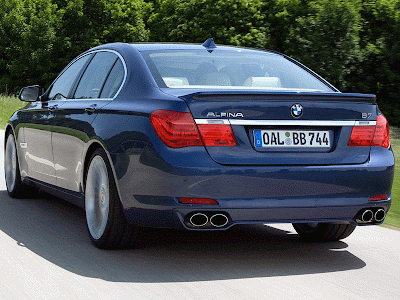
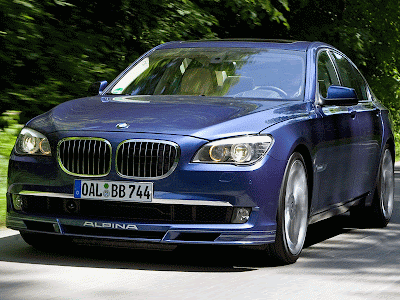
ALPINA B7 BMW luxury Sport Sedan

Both short- and long-wheelbase models will be offered. The BMW ALPINA B7 will make its North American premiere at the 2010 Chicago Auto Show in February, and go on sale at authorized BMW Centers in Spring of 2010. Bmw announced today the prices for the 2011 Alpina B7 for US - $122,875 (standard wheelbase) and $126,775 (extended wheelbase). BMW of North America announced that the BMW ALPINA B7 sedan will join BMW’s North American product range as the most dynamic 7 Series model. The BMW ALPINA B7 represents the second generation of ALPINA automobiles based on the BMW 7 Series to be offered in the US. The first BMW ALPINA B7 was offered as a limited edition for the 2007 and 2008 model years. Newly interpreted and based on the current BMW 7 Series platform, the B7 will again set the benchmark in terms of performance, refinement, technology, luxury and exclusivity. However, Alpina B7 is slightly less powerful that the 760i, but it looks very very sporty and aggressive.
ALPINA B7 BMW luxury Sport Sedan

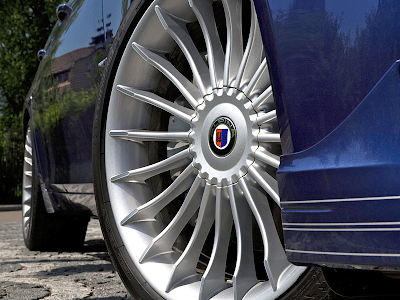
Yielding exquisite levels of power and torque from the twin-turbocharged 4.4 liter V8, and in conjunction with the electronically-adjustable suspension with active roll stabilization, the new B7 promises to offer a spectrum of driving experiences so broad as to be unheard of in this class of automobiles. The evolution of the traditional 20-spoke 21” ALPINA CLASSIC wheels underline the fresh design language found throughout the B7 and impart it a distinctive appearance and powerful stance.
ALPINA – a name famous in Europe and the wider world for putting a particular performance accent on BMWs, though not yet so well-known in North America. BMW – a name famous all over the world for motor vehicles of performance, quality, luxury and safety.
The two companies, both at home in the German state of Bavaria, have a long history of working together to produce special BMW automobiles. Burkard Bovensiepen, son of the founder of ALPINA Business Machines and an enthusastic racing driver/engineer, began his automotive career path in 1961 by developing a dual-carburetor setup for the just-introduced BMW 1500 sedan. It was a predictive beginning: to take an already fine-performing BMW (which also just happened to be a practical sedan) and making it perform even better.
ALPINA B7 BMW luxury Sport Sedan

By 1964, BMW had officially recognized ALPINA’s contribution to BMW performance. Not long thereafter, Burkard Bovensiepen founded the ALPINA company – ALPINA Burkard Bovensiepen KG – that continues today, creating special versions of BMW automobiles that offer a particular brand of performance for discriminating auto enthusiasts. Yet outside the circle of dedicated BMW enthusiasts, ALPINA has kept a low profile in North America. In addition to racing versions of BMWs, ALPINA has developed a progression of BMW-based cars based on 3, 5, 6, 8, Z4 and Z8 models and offered them on a limited-production basis. ALPINA is located in the small Bavarian city of Buchloe, some 50 miles southwest of Munich, BMW’s headquarters city and the capital of Bavaria.
ALPINA B7 BMW luxury Sport Sedan

The B7 is the newest manifestation of the unique BMW-ALPINA synergy – once again based on the BMW 7 Series luxury sedan. Currently, BMW offers ultra-performance models of its 3, 5, 6, X5 and X6 Series developed by BMW M, BMW’s own performance subsidiary. For an ultra-performance version of the 7 Series – a vehicle defined by luxury and generous interior space – something other than “M” performance character was called for. In recent models, ALPINA has concentrated on delivering very high levels of performance with moderate rpm ranges and automatic transmission. Most appropriately, the new BMW ALPINA B7 applies this philosophy to the newest 7 Series to produce a luxury sedan of stunning performance. “A 7 Series Beyond,” one might say.
Twitter Delicious Facebook Digg Stumbleupon Favorites More

 
Design by Free WordPress Themes | Bloggerized by Lasantha - Premium Blogger Themes | Best Buy Printable Coupons